
Selecting a web hosting package is one of the most foundational decisions for any online venture. More than just a digital landlord for your website’s files, your hosting provider impacts everything from page load speed and security to user trust and long-term scalability. A superior host can accelerate growth and enhance your brand’s reputation, while a poor choice can lead to lost revenue, frustrated visitors, and a constant stream of technical headaches.
5 Factors to consider with your Webhosting Package
This guide will demystify the selection process by breaking down the five most critical factors to evaluate, empowering you to choose a hosting package that aligns perfectly with your technical needs, budget, and strategic goals.
1. Performance and Reliability: The Foundation of User Experience

In today’s fast-paced digital landscape, performance and reliability are non-negotiable pillars of a successful website. Slow loading times and frequent downtime don’t just create a poor user experience—they directly harm user engagement, damage conversion rates, and diminish your search engine rankings.
As AI-driven search tools like Google’s AI Overviews become more prevalent, the tolerance for slow, undependable sites is shrinking, making high-performance hosting an essential investment for visibility and success.
Analyze Core Performance Metrics
To objectively assess a host, start by evaluating these key performance indicators:
- Uptime Guarantee: Uptime measures a server’s operational consistency. While the industry standard is 99.9%, this still allows for nearly nine hours of potential downtime per year. In contrast, premium providers offer 99.99% or even 100% uptime guarantees, reducing potential outages to mere minutes annually. This small percentage difference can have a significant impact on your revenue and credibility.
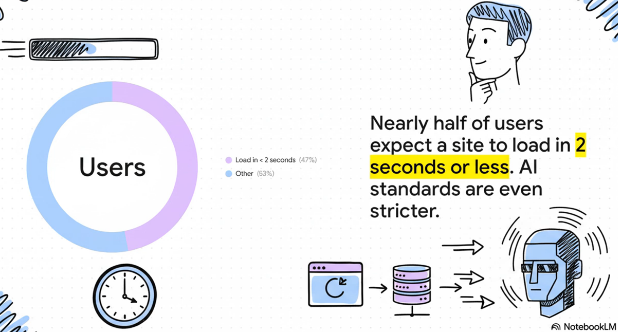
- Website Speed: Modern users are impatient. Research shows that 47% of users expect a website to load in two seconds or less. Every fraction of a second counts, as delays can lead to visitors abandoning your site before your content even appears.
- Server Response Time (TTFB): Time to First Byte (TTFB) measures how quickly the server begins sending data after receiving a request. It’s a pure indicator of server responsiveness. Look for providers that meet these benchmarks:
- Excellent: 200–400 ms
- Good: 400–600 ms
Assess the Underlying Technology
Superior performance is driven by modern infrastructure. Look for a hosting provider that leverages cutting-edge technology to deliver speed and stability. Key features include high-speed NVMe SSD storage, which is significantly faster than traditional SSDs, and server-level caching layers that reduce database load and accelerate page generation. A built-in Content Delivery Network (CDN) is also crucial, as it distributes your website’s static assets across a global network, ensuring fast load times for visitors regardless of their location. Finally, the ability to choose from global data center locations allows you to host your site closer to your primary audience, further reducing latency.
Performance Comparison
Independent testing reveals significant performance variations among popular providers. The following table compares key metrics for three well-known hosts based on recent data. Note that the time metric for SiteGround reflects server response under a concurrent user load, while the others measure Time to First Byte (TTFB), offering different but valuable perspectives on server responsiveness.
| Provider | Average Load/Response Time (ms) | Uptime Guarantee (%) |
| SiteGround | 147 (under load) | 99.99% |
| Hostinger | 443 (TTFB) | 99.99% |
| Bluehost | 472 (TTFB) | 99.97% |
A high-performing server is the first step, but its resilience against threats is equally important. This leads directly to our next critical factor: security.
——————————————————————————–
2. Security and Compliance: Protecting Your Digital Assets and Customer Trust
Website security is not an optional add-on; it is an absolute necessity in an era of increasingly sophisticated cyber threats. A robust security posture is fundamental to protecting sensitive company and customer data, building invaluable user trust, and avoiding the severe financial and reputational damage that can result from a security breach.
Evaluate Essential Security Features
A comprehensive hosting package should include a multi-layered defense strategy. Ensure your chosen provider offers these core security features:
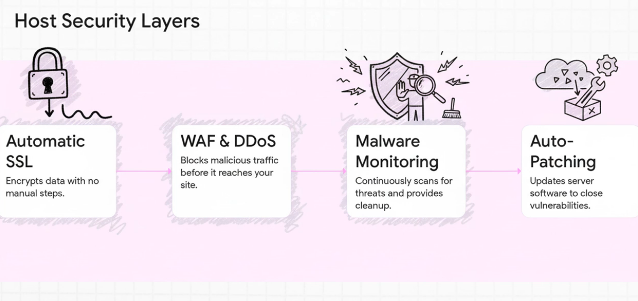
- SSL Certificates: An SSL certificate encrypts the data transmitted between a user’s browser and your server, securing sensitive information like login credentials and payment details. Most reputable hosts now provide free SSL certificates with their plans.
- Web Application Firewall (WAF) & DDoS Protection: A WAF acts as a shield, blocking malicious traffic like SQL injection attempts and cross-site scripting before it can reach your website. Distributed Denial-of-Service (DDoS) protection ensures your site remains online even when targeted by attacks designed to overwhelm it with traffic.
- Malware Monitoring and Cleanup: Proactive security is critical. Your host should continuously scan for malware and other threats. Plans that include fast, effective cleanup are invaluable, as they can resolve an infection before it causes significant damage.
- Automated Backups: Regular, automated backups are your ultimate safety net. In the event of a hack, data corruption, or critical error, the ability to restore a recent, clean version of your site is indispensable. Daily backups should be the standard.
- Automated Security Patching: A secure host automatically updates server software, PHP versions, and other platform components to patch vulnerabilities as they are discovered. Manual patching can leave dangerous security gaps.
The Critical Role of PCI Compliance
For any business that processes credit card payments directly on its website, compliance with the Payment Card Industry (PCI) Data Security Standard is non-negotiable. This set of standards, created by major credit card companies, ensures the secure processing, storage, and transmission of cardholder data. Failure to remain PCI compliant can lead to severe consequences, including hefty fines and the suspension of your credit card processing privileges. It’s crucial to verify a provider’s compliance status directly, as it can change. For example, reports indicate that SiteGround is no longer PCI compliant, making it essential for e-commerce businesses to confirm this detail before committing.
Once you have established a secure and compliant foundation, the next strategic consideration is ensuring your infrastructure can accommodate future growth without becoming a bottleneck. This brings us to the critical importance of scalability.
——————————————————————————–
Scalability and Hosting Types: Choosing a Plan That Grows With You
Choosing a hosting solution that can support your website’s growth over time is a strategic imperative. The right plan allows you to seamlessly expand resources to handle increasing traffic and functionality.
The wrong choice can create a performance bottleneck that frustrates users or, worse, force a complex and disruptive migration to a new provider just as your business is gaining momentum.
Compare Key Hosting Models
Understanding the primary types of hosting is the first step toward making a future-proof decision.
| Hosting Type | Key Characteristics | Ideal For |
| Shared Hosting | The most cost-effective option where multiple websites share a single server’s resources. Prone to “noisy neighbor” issues if one site uses excessive resources and may have a limited number of email users and emails received per hour. | Personal blogs, portfolio websites, and small businesses with low to moderate traffic. |
| VPS (Virtual Private Server) Hosting | Pros: Provides dedicated resources (CPU, RAM) and higher uptime than shared hosting; offers better email deliverability. Cons: Still shares a physical server, which can limit its ability to handle very high traffic spikes. | Growing businesses, e-commerce stores, and websites that have outgrown shared hosting. |
| Dedicated Hosting | An entire physical server is devoted to a single website. Offers maximum performance, control, and security but is the most expensive option. | Large corporations, high-traffic e-commerce sites, and applications with sensitive data. |
Understand Cloud Hosting and Upgrade Paths
Distinct from the traditional models, Cloud Hosting represents a highly flexible and scalable alternative. Instead of relying on a single physical server, it utilizes a network of connected servers to host your website. This architecture allows it to automatically allocate more resources to handle sudden traffic spikes, effectively eliminating the performance “ceiling” found in shared hosting and ensuring your site remains fast and stable. When evaluating any provider, always assess their upgrade path. A quality host makes it easy to transition between plans—for example, from a shared plan to a VPS—with minimal downtime as your website’s needs evolve.
While scalable infrastructure provides the technical capacity for growth, the quality of human support and platform usability determines how efficiently you can manage that expansion. This shifts our focus to the crucial factors of support and ease of use.
4. Support and Ease of Use: Your Partner in Problem-Solving

Beyond server specifications, the quality of a host’s customer support and the usability of its platform are crucial factors that can significantly impact your daily operations.
Responsive, expert support can be the difference between a quick resolution and a prolonged crisis that costs you traffic and sales. Likewise, an intuitive control panel saves valuable time and minimizes the technical frustration of managing your website.
Assess the Quality of Customer Support
Not all support teams are created equal. Look for these key indicators of high-quality service:
- Availability: Problems don’t adhere to a 9-to-5 schedule. 24/7 support is essential for peace of mind, ensuring help is available whenever an issue arises.
- Support Channels: A good host offers multiple ways to get in touch, including live chat, phone, and ticket-based email systems. Be aware of limitations; for example, some providers like Hostinger do not offer phone support, which could be a critical drawback during an urgent issue.
- Technical Expertise: Evaluate the depth of the support team’s knowledge. While some providers offer general assistance, others, like Bluehost and SiteGround, provide access to WordPress-certified experts who can effectively troubleshoot complex application-specific problems.
Prioritize User-Friendliness
An accessible hosting platform empowers you to manage your site efficiently. Key features that contribute to ease of use include a modern, user-friendly control panel. While industry standards like cPanel and Plesk are widely used and powerful, some hosts offer excellent custom-built dashboards designed for simplicity. Additionally, look for the availability of one-click installers for popular applications like WordPress, WooCommerce, and Magento, which can automate and simplify the setup process dramatically.
While strong support adds immense value, it’s crucial to balance it with a clear understanding of the total financial commitment.
5. Pricing and Total Cost of Ownership (TCO): Looking Beyond the Introductory Offer
It’s easy to be enticed by banner ads promoting web hosting for just a few dollars a month. However, these low introductory prices often conceal a much higher long-term cost.
To make a financially sound decision, it is essential to look beyond the promotional period and calculate the Total Cost of Ownership (TCO), analysing all potential costs over a multi-year horizon to avoid unexpected expenses.
The “Introductory Pricing Paradox”
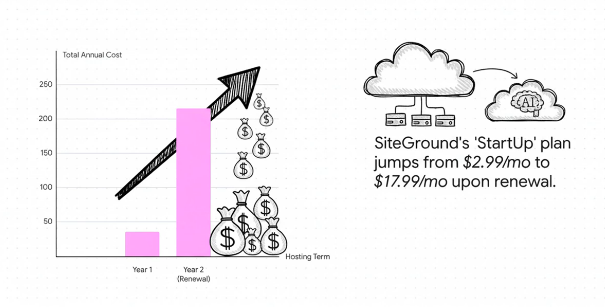
A common tactic in the hosting industry is to offer a deeply discounted price for the initial term, only to have it increase significantly upon renewal. For example, a plan might be advertised at $2.99 per month for the first year but jump to $17.99 per month afterward. This strategy can turn an affordable entry point into an expensive long-term commitment. Always check the renewal rates upfront before making a decision.
Identify Potential Additional Costs
The renewal rate is often just one of several expenses that contribute to the TCO. Be sure to investigate these other potential fees:
- High Renewal Rates: The most common hidden cost, where the price for the second term can be two to six times higher than the introductory offer.
- Domain Name Registration: Many hosts offer a “free” domain, but this is typically only for the first year. Be sure to check the domain renewal cost.
- Migration Fees: While some providers offer a free service to move your existing website, others charge a fee for migration assistance.
- Limited Email Accounts: Some entry-level plans restrict you to a single professional email account, requiring an upgrade to add more for your team.
- Paid Add-ons: Essential features like advanced security, premium SSL certificates, or specialized marketing tools may not be included in a base plan and will incur extra charges.
It’s worth noting that some providers are exceptions to this rule. For instance, AccuWeb Hosting is recognized for offering plans with no renewal price hikes, providing more predictable long-term costs. By looking beyond the sticker price to the TCO, you can make a financially sustainable choice, bringing all five critical factors into a unified decision-making framework.
——————————————————————————–
Web Hosting: Making a Confident and Informed Decision
Choosing the right Web Hosting Package requires a thoughtful evaluation of more than just a single feature or a low introductory price. By systematically analysing the five critical factors—Performance, Security, Scalability, Support, and Pricing—you can move beyond marketing claims and assess which provider truly meets your needs.
The ideal web host is not a one-size-fits-all solution; it is a strategic partner whose capabilities must align with the specific goals, budget, and technical comfort level of your project. By using this framework as a practical checklist, you can confidently evaluate your options and select a hosting provider that will serve as a reliable and powerful foundation for your online success.